Deciding how to get a welding job done often comes down to one question: should the work happen on your site, or should the parts come to a workshop? Both approaches deliver strong, safe results when handled by the right team, but the smartest choice depends on your project size, location, urgency and complexity. At Alpha Welding, we run both a fleet of mobile welding teams and fully equipped workshops, so we can give honest, practical advice rather than pushing you towards one method. If you want a quick answer for your specific job, you can always get in touch with our team and we will point you in the right direction.
What a Mobile Welder Actually Does
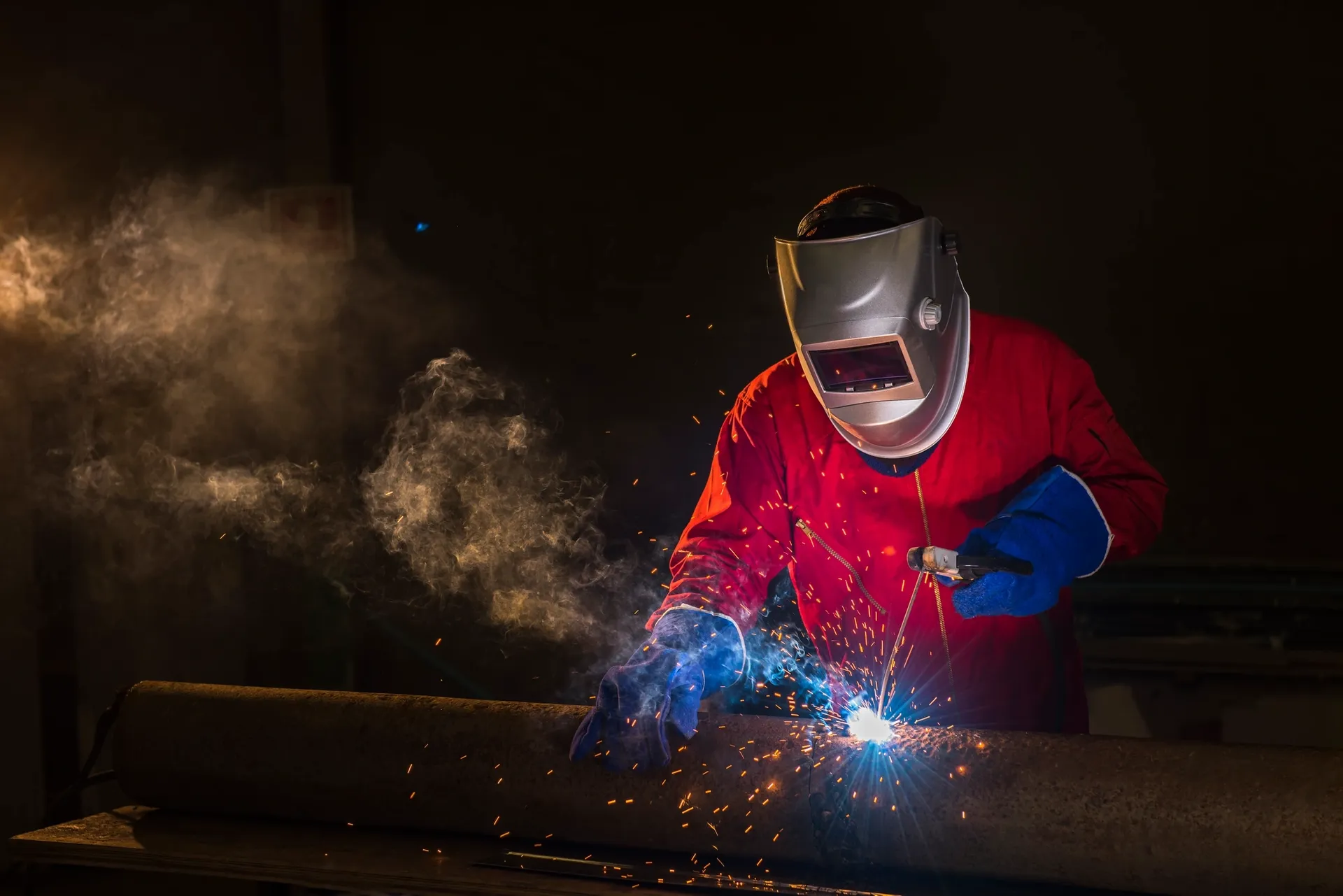
A mobile welder brings the complete welding and cutting setup directly to your location. That means welding plant, a mobile generator, consumables, access equipment and fire controls all arrive ready to work, whether you are on a construction site, at a farm, in a warehouse or at a commercial premises.
This approach is built for assets that cannot easily move. Structural steelwork, installed handrails, plant and machinery, gates and large fabrications are often too big, too heavy or too fixed in place to transport. Trying to move them would be costly, slow or simply impractical. On-site welding solves that by taking the workshop to the job.
Our mobile teams handle everything from crack repairs and reinforcement plates to RSJ connections, wear plates, bracket fabrication and site welding and burning. We regularly carry out emergency call-outs too, whether it is impact damage, a broken weld or a safety-critical defect that needs making safe quickly.
What Workshop Welding Offers
Workshop welding, sometimes called fabrication welding, takes place in a controlled environment. Your materials or components come to us, where we work with heavy-duty equipment, jigs, positioners and precise measuring tools under ideal conditions.
The workshop is where controlled fabrication shines. Clean surroundings, consistent lighting, fixed benches and specialist machinery all support tighter tolerances and repeatable accuracy. For custom builds, complex assemblies and projects with exacting engineering requirements, a workshop is usually the better route.
Our workshops in Rudgwick, West Sussex, are where a lot of our bespoke work comes to life, from full vehicle restorations to design-and-build staircases and custom steelwork. When precision and finish matter most, this setting gives us the space and tooling to deliver.
The Key Differences at a Glance
The table below summarises how the two methods compare across the factors that usually decide a project.
| Factor | Mobile welder | Workshop welding |
| Location | Work happens at your site | Parts brought to the workshop |
| Best for | Fixed, large or installed assets | Custom builds and complex fabrication |
| Speed for urgent jobs | Fast, ideal for same-day welding services | Slower, subject to transport and scheduling |
| Precision and finish | Excellent, suited to field conditions | Highest, with jigs and controlled setup |
| Transport costs | Minimal for you, no moving heavy parts | Added cost to move materials |
| Downtime | Reduced, work fits around operations | Higher if equipment must leave site |
| Typical use | Repairs, reinforcement, emergency call-outs | Bespoke fabrication and precision assemblies |
When a Mobile Welder Is the Better Choice
Choosing a mobile welder makes sense in a few clear situations.
- The asset cannot move. Structural beams, installed pipework, machinery and fixed steelwork are far easier to repair in place.
- You need speed. For urgent welding repair or a welding call out service, on-site work removes the delay of disassembly and transport. Where our schedule allows, we offer same-day welding services to keep you moving.
- Downtime is expensive. On active construction and industrial sites, every hour of stopped work costs money. On-site repairs keep operations running with minimal interruption.
- Access is limited or remote. Farms, trackside locations and sites without power all suit a generator-backed mobile welding call out.
Our project history shows this in practice. We welded in support plates for the ground anchors on the M27 Smart Motorway Scheme, carried out emergency bank stabilisation work involving the removal of sheet piles at Witley Station, and completed on-site handrail fabrication for a four-storey London office building. Each job needed skilled work delivered where the asset lived, not in a workshop. You can browse more examples on our projects page.
When Workshop Welding Is the Better Choice
A workshop is usually the stronger option when the work itself, rather than the location, drives the decision.
- Precision is critical. Tight tolerances and repeatable results benefit from jigs, positioners and a stable setup.
- You need something built from scratch. Custom fabrication, bespoke frames and complex assemblies are far easier to control indoors.
- The parts are easy to move. If components are small and not installed in place, bringing them to us is often more efficient.
- Finish quality matters. Cleaner conditions support better surface preparation, priming and protective coatings.
If you are unsure which side of the line your job sits on, a quick conversation usually settles it. Describe the task, share a few photos and we will tell you honestly whether mobile or workshop welding will serve you best.
When a Hybrid Approach Works Best
Many larger projects do not fit neatly into one category, and that is where a combined approach pays off. Components are fabricated in the workshop to precise specifications, then transported and installed on-site by a mobile team. This is common across construction, rail, infrastructure and commercial work.
We use this method regularly. A staged job might mean pre-fabricating brackets, plates or sections in Rudgwick, then making the site safe and returning to complete the final installation. It gives you the accuracy of workshop fabrication with the practicality of on-site assembly, without compromising on either.
Cost, Quality and Safety: What Really Matters
Cost often drives the decision, but it pays to look at the full picture. A mobile welder may include a call-out element, yet it usually saves far more on transport, craneage and downtime. Workshop welding can carry lower per-weld overheads but adds the expense of moving heavy components. The right choice is the one that reduces your total cost and disruption, not just the headline figure.
On quality, a well-executed mobile weld meets the same structural standards as a workshop weld when it is completed by a qualified welder using the correct process. What matters is competence, preparation and control rather than location alone. Our work is carried out to coded welder standards, with sound joint preparation, correct heat input and compatible filler selection every time.
Safety underpins everything, especially on occupied or high-risk sites. We prepare method statements and risk assessments, manage hot works permits and follow fire watch and isolation procedures as standard. This is backed by industry-recognised accreditations including CSWIP and Code A Weld, CSCS, TWI affiliation and Network Rail Sentinel, which shape how we plan, execute and document every job.
Why Alpha Welding Can Advise on Both
Founded in 2012 by Charley Moroney, Alpha Welding started as a one-man operation and has grown into a trusted welding company serving businesses and contractors across the South East. Because we operate both mobile teams and fully equipped workshops, we are not tied to one method. That means our recommendation is based on what genuinely suits your project, not what is convenient for us. You can read more about our team and background to see how we work.
We support domestic, commercial and industrial clients, and we are trusted by major contractors including BAM Nuttall, Balfour Beatty, Octavius and Pro Rail Services. From plant and machinery repairs to structural steel repairs and steelwork modification, our welding services cover the full range in both settings.
Call us today on 01403 458874 or visit our contact page to secure your free quote and discuss your requirements with our expert team. You can also email info@alphawelding.co.uk with the details of your project.
Frequently Asked Questions
Yes. When completed by a qualified welder using the correct process and proper preparation, an on-site weld meets the same structural standards as one produced in a workshop. Quality depends on competence and control, not the setting.
Pricing depends on the job, location and access. Any call-out element is usually offset by the savings on transport, craneage and downtime. We always provide a clear quote before starting so there are no surprises.
Response times depend on location, access and current workload, but our mobile teams are set up for urgent welding repair and, where scheduling allows, same-day welding services across the South East. Send us the details and photos for the fastest confirmation.
Absolutely. A hybrid approach is common on larger projects. We pre-fabricate components to specification in our Rudgwick workshops, then install them on-site with a mobile team, giving you both precision and practicality.
Ideally the work area should be clear of flammable materials with reasonable access and ventilation. We will confirm any specific site requirements, permits or controls when you book, so everything is in place before we arrive.
It varies by project. For fixed or heavy assets, mobile welding usually works out more economical once transport and downtime are factored in. For small, movable components needing high precision, workshop welding can be more cost-effective. A quick chat will identify the better value option for you.